
If your business feels more tech disruptions between April and June, you’re not imagining it. IT outages in Q2 are a consistent pattern across small and mid-sized businesses. While most companies assume outages are random, the reality is more predictable.
Q2 creates the perfect storm of system stress, human error, and infrastructure changes. As a result, businesses that don’t prepare often experience downtime at the worst possible moment.
Understanding why this happens allows you to prevent it. More importantly, it helps you avoid lost revenue, frustrated employees, and damaged customer trust.
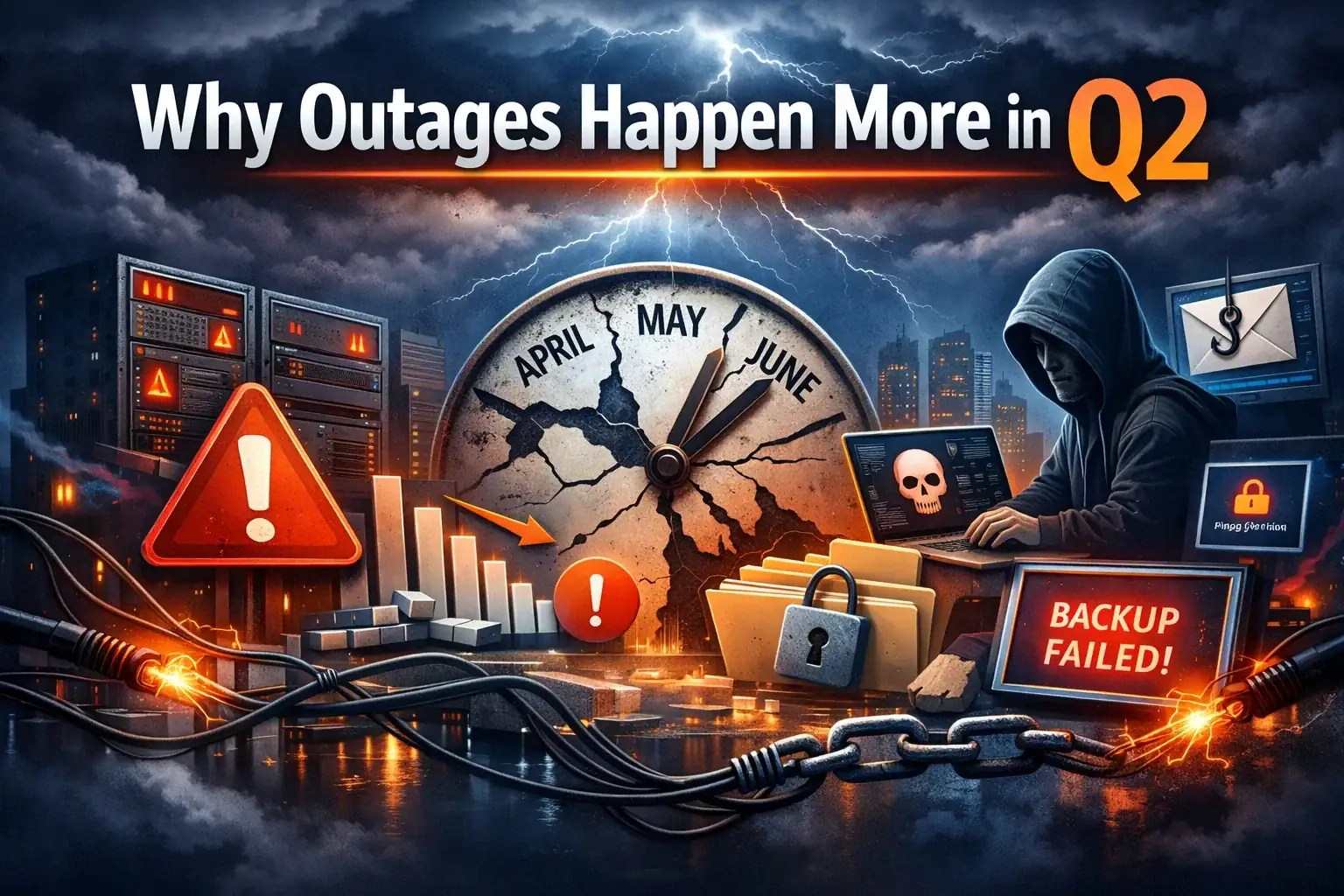
1. Post-Q1 Changes Start Breaking Things
Q1 is planning season. Businesses upgrade systems, adopt new tools, and adjust workflows. However, those changes don’t always fail immediately.
Instead, problems surface in Q2.
- New software integrations begin conflicting
- Misconfigured systems reveal gaps
- Security policies get bypassed for convenience
These issues often remain hidden until usage increases. Then, systems begin to slow down or fail entirely.
This aligns with a broader trend: businesses are rapidly modernizing IT systems, often without the internal resources to manage complexity .
Key insight: Q2 doesn’t create problems—it exposes them.
2. Increased Activity Puts Pressure on Systems
Business activity typically ramps up in Q2.
- Construction and field operations increase
- Healthcare and service industries see higher volume
- Travel and remote work expand
More users, more devices, and more data create higher system demand. If your infrastructure isn’t scaled properly, performance issues follow.
Additionally, hybrid work environments add complexity. Over half of SMBs now support some level of remote work . That means:
- More VPN usage
- More unsecured networks
- More endpoints to manage
Every added variable increases the chance of failure.
3. Security Threats Increase After Tax Season
Cybercriminals follow patterns. After tax season, they shift focus toward small businesses that are:
- Financially active
- Handling sensitive data
- Distracted by growth or operations
Phishing campaigns, credential theft, and ransomware attempts often rise in Q2. Many attacks don’t immediately shut down systems. Instead, they create instability first.
For example:
- Compromised credentials lead to unauthorized access
- Malware slows systems before triggering larger events
- Weak passwords create silent entry points
Credential-based attacks remain the #1 way businesses get breached .
Key insight: Many “outages” are actually security incidents in disguise.
4. Poor Backup Verification Comes to Light
Most businesses assume their backups work.
Few actually test them.
Q2 is when that assumption gets challenged.
- Backups fail silently due to storage issues
- Recovery processes haven’t been tested
- Data isn’t as complete as expected
When a system goes down, businesses discover too late that recovery isn’t possible—or takes far longer than expected.
According to standard IT evaluation practices, many companies can’t confirm whether their last backup even completed successfully .
Key insight: A backup you haven’t tested is a risk, not a solution.
5. Staff Turnover and Workflow Gaps
Q2 often brings staffing changes.
- Seasonal hiring
- Role transitions
- Employees leaving after Q1 reviews
Without proper onboarding and offboarding processes, systems become vulnerable.
Common issues include:
- Old accounts still active
- Shared passwords across teams
- Missing documentation for systems
Small businesses especially feel this impact. Many rely on manual processes and lack structured IT oversight .
This creates both security risks and operational disruptions.
6. Lack of Proactive Monitoring
Most outages don’t happen instantly. They build over time.
However, without monitoring, businesses don’t see warning signs.
- Devices overheat or slow down
- Network traffic spikes unexpectedly
- Software conflicts escalate
By the time users notice, the problem has already caused downtime.
This is where many providers fall short. Reviews across MSPs consistently highlight issues like delayed response times and inconsistent support .
Key insight: Reactive IT guarantees outages. Proactive IT prevents them.
What Texas SMBs Should Do Right Now
Q2 outages are predictable. That means they’re preventable.
Here’s how to reduce your risk immediately:
1. Validate Your Backups
- Run a full restore test
- Confirm recovery time (RTO)
- Ensure backups are encrypted and offsite
2. Lock Down Credentials
- Implement a password manager
- Enforce MFA across all accounts
- Eliminate shared passwords
3. Monitor Everything in Real Time
- Track device health
- Watch network activity
- Set alerts for anomalies
4. Review Recent Changes
- Audit Q1 upgrades and integrations
- Fix misconfigurations early
- Document all systems
5. Strengthen Onboarding/Offboarding
- Remove unused accounts
- Standardize access control
- Document processes

Want a quick way to improve online privacy? SurfsharkVPN helps protect your connection on public Wi-Fi, while traveling, or when working remotely. If you sign up through our link, we may earn a commission at no extra cost to you.
The Bigger Pattern Most Businesses Miss
Here’s the uncomfortable truth:
Outages1 don’t increase in Q2 because of bad luck.
They increase because businesses carry hidden risk out of Q1 and only notice it under pressure.
Most SMBs operate in a reactive cycle:
- Something breaks
- It gets fixed
- The root cause remains
That cycle guarantees repeat outages.
Competitors in the MSP space often overlook this by focusing on broad “cybersecurity” messaging instead of measurable outcomes like response time, recovery speed, and system stability .
This is where strategy matters.
Where We Fit In
At SofTouch Systems, the goal is simple:
That means:
- Transparent systems
- Proactive monitoring
- Verified backups
- Predictable performance
Instead of waiting for outages, systems are continuously monitored, tested, and optimized. The result is fewer disruptions and faster recovery when issues do occur.
This approach reflects a broader shift in the industry. SMBs are increasingly investing in managed IT services to improve resilience and reduce downtime risk .
Ultimately…
Q2 doesn’t cause outages.
It reveals whether your IT is built to handle real-world pressure.
If your systems haven’t been tested, monitored, or secured properly, Q2 will find the weakness.
The question isn’t if something will break.
It’s whether you’ll see it coming.

SofTouch Systems
If you want to know where your risks are before they turn into downtime:
Schedule a Free IT Evaluation with SofTouch Systems.
We’ll review your backups, security, and system health, so you can move through Q2 with confidence, not surprises.
- In business IT, an outage is a period during which a system, application, network, or piece of equipment is not operational, preventing users from accessing services or performing their tasks. It is defined as a temporary cessation of normal service operation. ↩︎
Discover more from SofTouch Systems
Subscribe to get the latest posts sent to your email.