
A phishing email is dangerous when it looks real. Business email compromise can be even more dangerous because sometimes the email is real. The criminal may be communicating from the actual account of your employee, vendor, executive, or business partner.
That changes the problem completely.
There may be no misspelled domain to spot. No suspicious-looking sender. No obvious attachment. Instead, an attacker quietly gains access to a legitimate mailbox, watches normal business conversations, and waits for an opportunity to redirect money or steal sensitive information.
For a small Texas business, that makes business email compromise more than an email-security problem. It becomes a financial, operational, and cybersecurity problem.
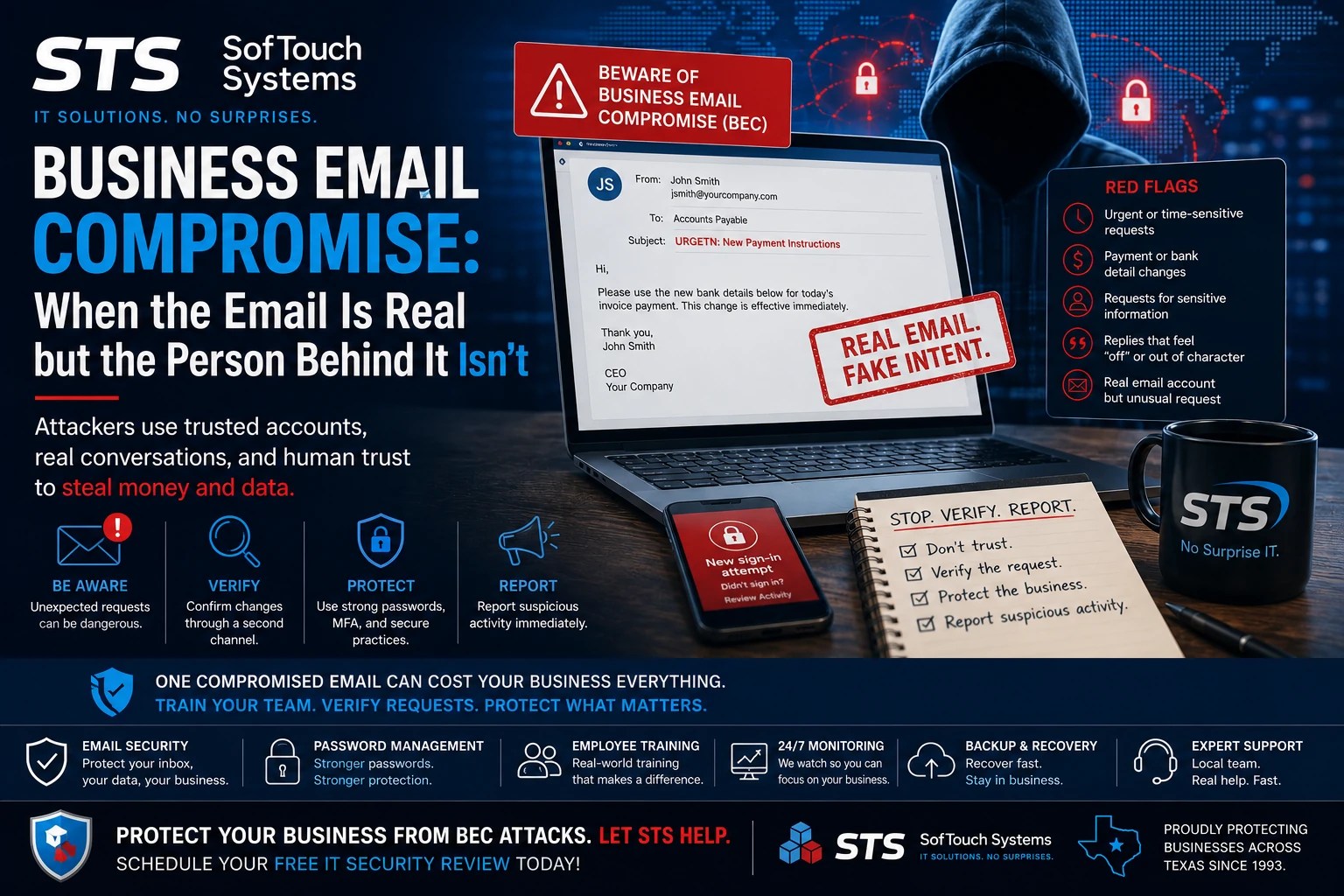
What Is Business Email Compromise?
Business email compromise, commonly called BEC, is a type of fraud in which criminals use business email communications to impersonate trusted people and manipulate legitimate transactions.
The FBI describes BEC as a sophisticated scam targeting businesses and individuals who perform legitimate transfers of funds. Attackers may compromise legitimate email accounts through social engineering or computer intrusion and then use those accounts to request unauthorized payments or information.
The financial impact is substantial. The FBI’s 2024 Internet Crime Report recorded approximately $2.77 billion in reported BEC losses during 2024 alone.
However, the danger is not limited to large corporations.
The FBI specifically warns that BEC targets organizations ranging from small local businesses to large corporations.
That should matter to any small-business owner who uses email to approve invoices, manage payroll, communicate with vendors, or exchange sensitive information.
How Can a Real Email Become Part of an Attack?
Traditional phishing often attempts to imitate someone you trust.
BEC can go one step further.
The attacker may actually get inside a legitimate account.
That access might begin with:
- A stolen or reused password
- A phishing page that captures credentials
- A fraudulent MFA request
- Malware or an infected device
- A compromised third-party account
- Social engineering against an employee
Once inside, a patient attacker does not necessarily send a fraudulent email immediately.
They may watch.
They can learn who approves invoices, which vendors receive payments, how employees communicate, when major transactions occur, and what language people normally use.
Then the attacker strikes at the right moment.
The $215 Million Example: Attackers Watched Real Business Relationships
A federal case announced in April 2026 shows how serious this model has become.
The U.S. Department of Justice reported that 25 defendants had been convicted in an international BEC scheme involving approximately $215 million and more than 1,000 victims across 47 states and 19 countries.
The criminals compromised email accounts and used information from legitimate communications to facilitate fraud.
This was not simply a matter of sending thousands of poorly written messages and hoping someone clicked.
The criminals exploited existing business relationships.
That distinction is important.
A normal phishing email might pretend to be your supplier.
A BEC attacker may know who your supplier actually is, what you purchase from them, who handles the payments, and how the supplier normally communicates with your company.
That makes the fraudulent request much harder to recognize.
A Second Example: $4.8 Million Taken From a School District
Another 2026 case demonstrates that businesses are not the only targets.
In April, federal authorities announced the recovery of approximately $4.86 million fraudulently obtained from Dickinson Public Schools in North Dakota through a business email compromise scheme.
Fortunately, federal authorities were able to trace and seize the money.
Businesses should not assume they will always be that fortunate.
Once money leaves your account, recovering it can become difficult. That is why preventing the fraudulent transaction matters so much.
For Texas businesses, nonprofits, municipalities, clinics, professional offices, and school organizations, the lesson is the same:
An email involving money should never become trustworthy simply because it came from a familiar account.
What Does a Business Email Compromise Attack Look Like?
Imagine that your accounting employee regularly receives invoices from a local supplier.
One afternoon, the supplier emails:
“We’ve changed banks. Please use the attached payment instructions for this month’s invoice.”
The employee recognizes the supplier.
The conversation appears inside an existing email thread.
The invoice amount looks correct.
The sender’s email address is correct.
So accounting changes the banking information.
The problem?
The supplier’s mailbox was compromised two weeks earlier.
The criminal has been reading the conversation and waiting for the next payment.
Your employee didn’t necessarily fall for an obvious fake email.
They followed instructions sent through a trusted communication channel that was no longer trustworthy.
That is the heart of BEC.
BEC Is Not Just an Accounting Problem
Financial fraud receives the most attention, but compromised business accounts can create other problems.
Attackers may target:
Payroll.
An employee’s direct-deposit information suddenly needs to be “updated.”
Executives.
The owner supposedly needs an urgent payment completed before a meeting.
Vendors.
Banking instructions change shortly before a legitimate invoice becomes due.
Employees.
Someone from management requests W-2 information, customer records, credentials, or other sensitive data.
Customers.
A compromised company mailbox may be used to send fraudulent invoices to your customers.
That last scenario can damage more than your bank account.
It can damage your reputation.
Your customer may receive the fraudulent message from your real email account.
Why Password Security Matters
BEC frequently begins with account access.
That makes password security one of the first defensive layers.
Employees should not reuse the same password across business accounts. If another service suffers a breach and that password becomes exposed, criminals may try the same credentials against email, Microsoft 365, Google Workspace, CRM platforms, accounting software, and other systems.
STS takes a password-first security approach because identity sits at the center of so many modern business systems.
A managed password solution such as 1Password can help businesses create unique credentials, securely share appropriate accounts, manage employee access, and reduce dependence on passwords stored in browsers, spreadsheets, sticky notes, or memory.
However, password management should not stand alone.
Businesses also need MFA, employee training, account management, software updates, monitoring, and clear procedures for unusual requests.
MFA Helps, but Employees Still Need Training
Multi-factor authentication creates another barrier when someone steals a password.
Still, employees must understand how MFA attacks work.
If an employee receives an unexpected authentication request, they should not approve it simply because the notification looks legitimate.
The correct question is:
“Did I initiate this login?”
If the answer is no, the employee should deny the request and report it.
Security tools work best when employees understand what those tools are telling them.
That is why STS combines technology with practical employee education rather than assuming software alone will solve the problem.
Create a Second Verification Channel for Money
One of the strongest BEC defenses is surprisingly simple.
Verify important financial changes outside email.
If a vendor suddenly changes its bank account, call your established contact using a telephone number you already have.
Do not use the phone number contained in the suspicious email.
The same principle should apply to:
- Wire-transfer requests
- Direct-deposit changes
- Large purchases
- New payment accounts
- Unusual executive requests
- Requests for sensitive employee information
For higher-value transactions, businesses should also consider requiring approval from two people.
This creates another barrier between a compromised mailbox and your bank account.
Small Businesses Need Email Security Before Something Goes Wrong
Small businesses sometimes treat email as a basic utility.
It isn’t.
Your email system may contain invoices, customer information, password resets, vendor conversations, employee information, financial discussions, contracts, and links into nearly every cloud service your company uses.
That makes email one of your business’s most important security systems.
STS can help small businesses manage that environment through services that include:
- Managed email and domain services
- Password management
- MFA implementation
- Employee cybersecurity training
- Antivirus and malware protection
- Software and security updates
- 24/7 monitoring
- Remote IT support
- Backup and disaster recovery
- Security evaluations
The objective isn’t to add unnecessary complexity.
It is to make sure your technology, employees, and business procedures work together.
That is what No-Surprise IT should look like in practice.
What Should You Do If You Suspect Business Email Compromise?
Move quickly.
First, contact your IT provider and report the suspected compromise. Passwords may need to be changed, active sessions revoked, forwarding rules inspected, devices checked, and other accounts reviewed.
If money has already been transferred, contact your financial institution immediately.
Do not wait until tomorrow.
The FBI’s Internet Crime Complaint Center operates a Financial Fraud Kill Chain process designed to help freeze fraudulent transactions. In 2024, its Recovery Asset Team reported a 66% success rate across qualifying financial-fraud complaints it handled.
Time matters.
You should also preserve relevant emails and records rather than deleting the evidence.
Finally, determine what the compromised account could access. An email breach may be the beginning of the investigation rather than the end.
FAQ
Not exactly. Phishing commonly uses fraudulent messages to trick users into clicking links, opening attachments, or revealing information. BEC often involves impersonating trusted business contacts and may include an actual compromised email account.
MFA can significantly strengthen account security, but it is one layer of protection. Businesses should combine MFA with unique passwords, password management, employee training, monitoring, verification procedures, and account-management practices.
Small businesses routinely transfer money and valuable information but may have fewer security controls and less dedicated IT staff than larger organizations. Criminals do not need a multimillion-dollar target for an attack to be profitable.
Use a separate, trusted communication method. Call a known contact using a previously verified telephone number rather than contact information contained in the email requesting the change.
Contact your IT provider immediately. The response may include changing credentials, revoking active sessions, reviewing MFA, checking forwarding and mailbox rules, examining devices, identifying exposed information, notifying appropriate parties, and reviewing other connected accounts.

The Email Can Be Real and the Request Can Still Be Fraudulent
That is the lesson every small-business owner and employee should remember.
Cybersecurity awareness used to focus heavily on spotting obviously fake messages.
Today’s businesses need a more mature approach.
Sometimes the sender address is correct.
Sometimes the vendor is real.
Sometimes the invoice is expected.
Sometimes the attacker knows exactly what your employees are discussing.
Trust should come from verification, not simply from recognizing an email address.
SofTouch Systems helps Texas small businesses build practical layers of protection around their email, passwords, employees, devices, data, and daily operations.
If you are unsure whether your current email security, MFA, passwords, or employee procedures could withstand a business email compromise attack, start with a Free IT Security Review from STS.
Find the weakness before someone else does.
SofTouch Systems — No Surprise IT. Predictable. Proactive. Proven.
Discover more from SofTouch Systems
Subscribe to get the latest posts sent to your email.