
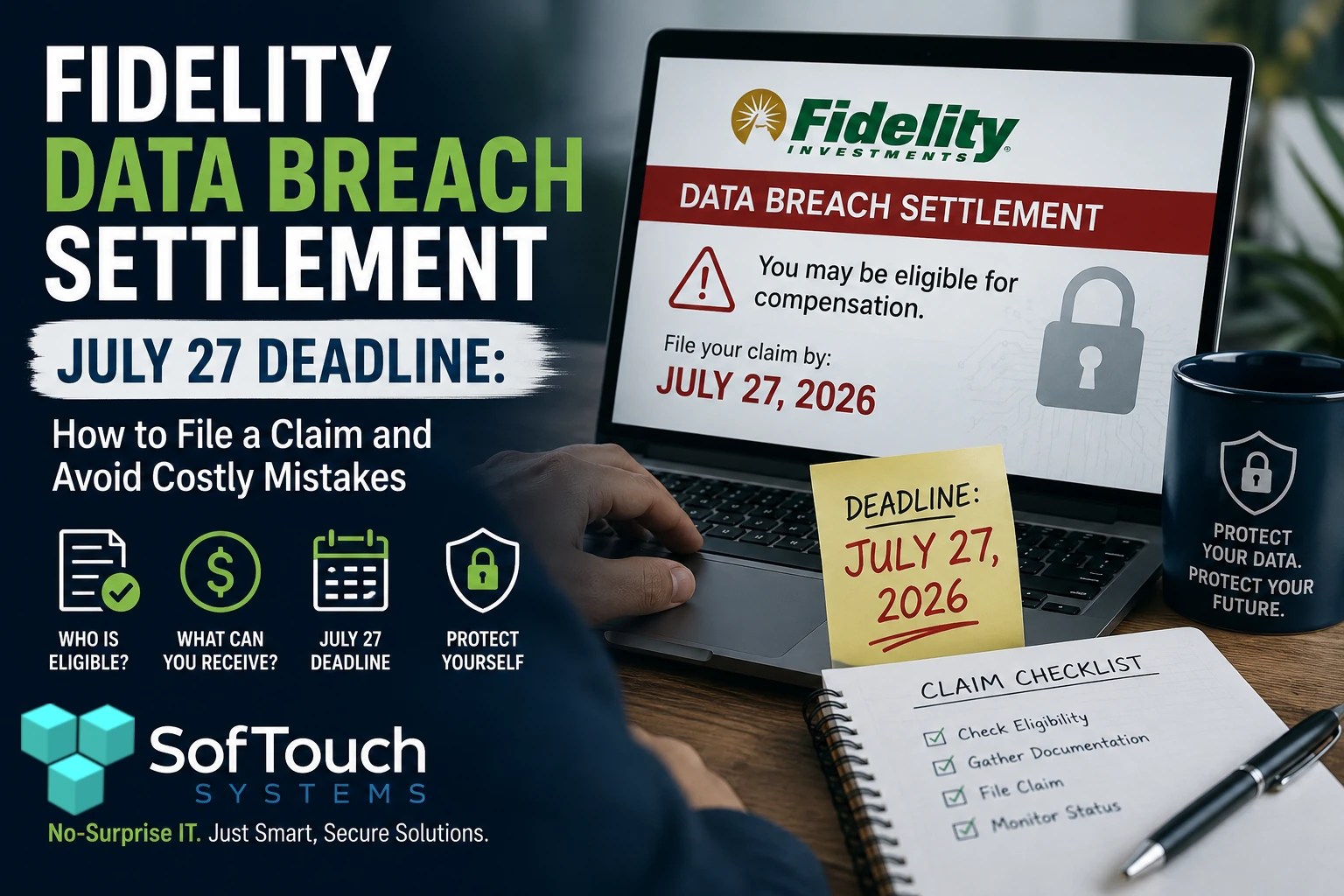
If you recently received a notice from Fidelity Investments about a data breach, don’t ignore it. You may be eligible to file a claim for compensation, but the deadline is July 27, 2026. More importantly, this incident serves as another reminder that no organization, no matter how large or well-funded, is immune to cyberattacks.
Whether you’re an individual investor or a small business owner, understanding what happened, what you’re entitled to, and how to protect yourself afterward can save you money and reduce your risk of identity theft.
What Happened?
According to the settlement, unauthorized individuals gained access to Fidelity’s systems during an incident that occurred between August 17 and August 19, 2024. While Fidelity has denied any wrongdoing, the company agreed to a $2.5 million class-action settlement to resolve claims related to the breach.
Depending on the individual, the exposed information may have included:
- Full names
- Social Security numbers
- Driver’s license numbers
- Financial account information
- Other personally identifiable information
If you received an official notification from Fidelity informing you that your information was involved, you may qualify to participate in the settlement.
Who Is Eligible?
Generally, you may be eligible if Fidelity notified you that your personal information was affected by the breach. Eligible individuals should have received a notice containing a Unique ID and PIN required to file a claim online.
If you’ve misplaced your notification, don’t panic. The Settlement Administrator may be able to assist you in confirming your eligibility.
The deadline to submit your claim is July 27, 2026.
Waiting until the last minute isn’t recommended. Settlement websites often experience heavy traffic as deadlines approach, and gathering any required documentation can take longer than expected.
What Can You Receive?
The amount you receive depends on your situation and the documentation you can provide.
Eligible claimants may receive reimbursement for documented out-of-pocket expenses directly related to the breach, up to the limits established by the settlement agreement. You may also qualify for a cash payment, although the final amount will depend on the total number of approved claims.
Some claimants may also be eligible for identity protection or credit monitoring services.
If you believe you’ve experienced financial losses related to the breach, gather your documentation before filing your claim. Receipts, bank statements, invoices, or correspondence related to fraudulent activity can help support your request.
Don’t Get… Creative
Whenever a class-action settlement makes the news, there’s always someone who suddenly remembers that the breach somehow caused every inconvenience they’ve experienced over the past two years.
“My coffee was cold that morning.”
“My Wi-Fi disconnected once.”
“I had to replace my favorite keyboard.”
Nice try.
The settlement is designed to compensate people for actual, documented losses caused by the data breach, not every purchase or bad day you’ve had since 2024.
If your bank charged fees because of fraudulent activity or you paid for identity restoration services, those may be legitimate expenses. Claiming your new 75-inch television as “cybersecurity equipment,” however, probably won’t end well.
Besides, filing a false claim isn’t clever. It’s fraud.
The Bigger Lesson Isn’t About Fidelity
It’s easy to read stories like this and assume they’re someone else’s problem.
After all, Fidelity is one of the largest financial services companies in the country. Surely they have sophisticated cybersecurity teams, advanced monitoring tools, and experienced security professionals.
They do.
Yet security incidents still happen.
That’s an important reminder that cybersecurity isn’t about finding a magical product that guarantees you’ll never experience a breach. It’s about reducing risk, limiting damage, and responding quickly when something goes wrong.
For individuals, that means using strong passwords, enabling multi-factor authentication (MFA), watching for phishing emails, and monitoring financial accounts regularly.
For businesses, the stakes are even higher.
What Businesses Should Learn
Many small business owners assume cybercriminals only target large corporations.
Unfortunately, attackers often prefer small businesses because they’re more likely to have outdated software, weak passwords, limited security monitoring, or no dedicated IT staff.
A single compromised employee password can lead to ransomware, stolen customer information, financial fraud, or days of costly downtime.
That’s why cybersecurity isn’t just an IT issue anymore, it’s a business continuity issue.
Even simple improvements can dramatically reduce risk:
- Use unique passwords for every account.
- Store passwords in a secure password manager.
- Enable multi-factor authentication wherever possible.
- Keep computers and software updated.
- Verify that backups are working.
- Train employees to recognize phishing emails.
- Monitor devices for unusual activity.
Cybersecurity isn’t built on one product. It’s built on layers of protection working together.
How SofTouch Systems Helps
At SofTouch Systems, we believe in No-Surprise IT. Instead of waiting until something breaks, or until you receive a breach notification, we help businesses stay ahead of everyday cybersecurity risks through proactive management and monitoring.
Our Monitored IT service combines managed antivirus protection with 24/7 system monitoring to identify issues before they become expensive problems.
Businesses looking for stronger credential protection can benefit from our Cyber Essentials Shield, which includes password management with 1Password, guidance for implementing multi-factor authentication, and practical security measures that employees can actually use.
For organizations that want more comprehensive protection, our Business Operations Shield combines managed IT services, cybersecurity, backup protection, and ongoing support into a complete solution designed for small businesses.
We also offer Backup & Disaster Recovery services to help businesses recover quickly from ransomware, accidental file deletion, hardware failures, or other unexpected disasters.
The goal isn’t to scare businesses into buying technology.
The goal is to help them avoid becoming tomorrow’s headline.
Final Thoughts
If you received a Fidelity data breach notification, take a few minutes to determine whether you’re eligible for the settlement. Filing a legitimate claim could help recover documented losses and provide additional identity protection.
Just don’t wait until July 27 to get started.
More importantly, use this incident as a reminder to review your own cybersecurity habits. Whether you’re protecting your family’s financial accounts or running a small business, proactive security measures are always less expensive than cleaning up after a breach.
Next Steps
At SofTouch Systems, we’ve spent more than 30 years helping Texas businesses reduce risk, improve security, and simplify technology through our No-Surprise IT approach. If you’re unsure whether your current cybersecurity protections are enough, schedule a free IT Security Evaluation with our team. We’ll help you identify potential vulnerabilities, strengthen your defenses, and build a practical security strategy that fits your business, not just your budget.
Because the best time to prepare for a cyberattack is before someone else writes the news story about it.
Discover more from SofTouch Systems
Subscribe to get the latest posts sent to your email.