
Artificial intelligence is becoming a standard business tool. Employees are using AI to write emails, analyze data, create marketing content, and automate repetitive tasks. While these tools can improve productivity, they also introduce new risks that many small businesses haven’t considered.
Questions like these are becoming increasingly common:
- Is it safe to upload company information into AI?
- How do we protect customer data?
- Should employees be allowed to use public AI tools?
- What policies should our business have in place?
Fortunately, you don’t have to figure it all out on your own.
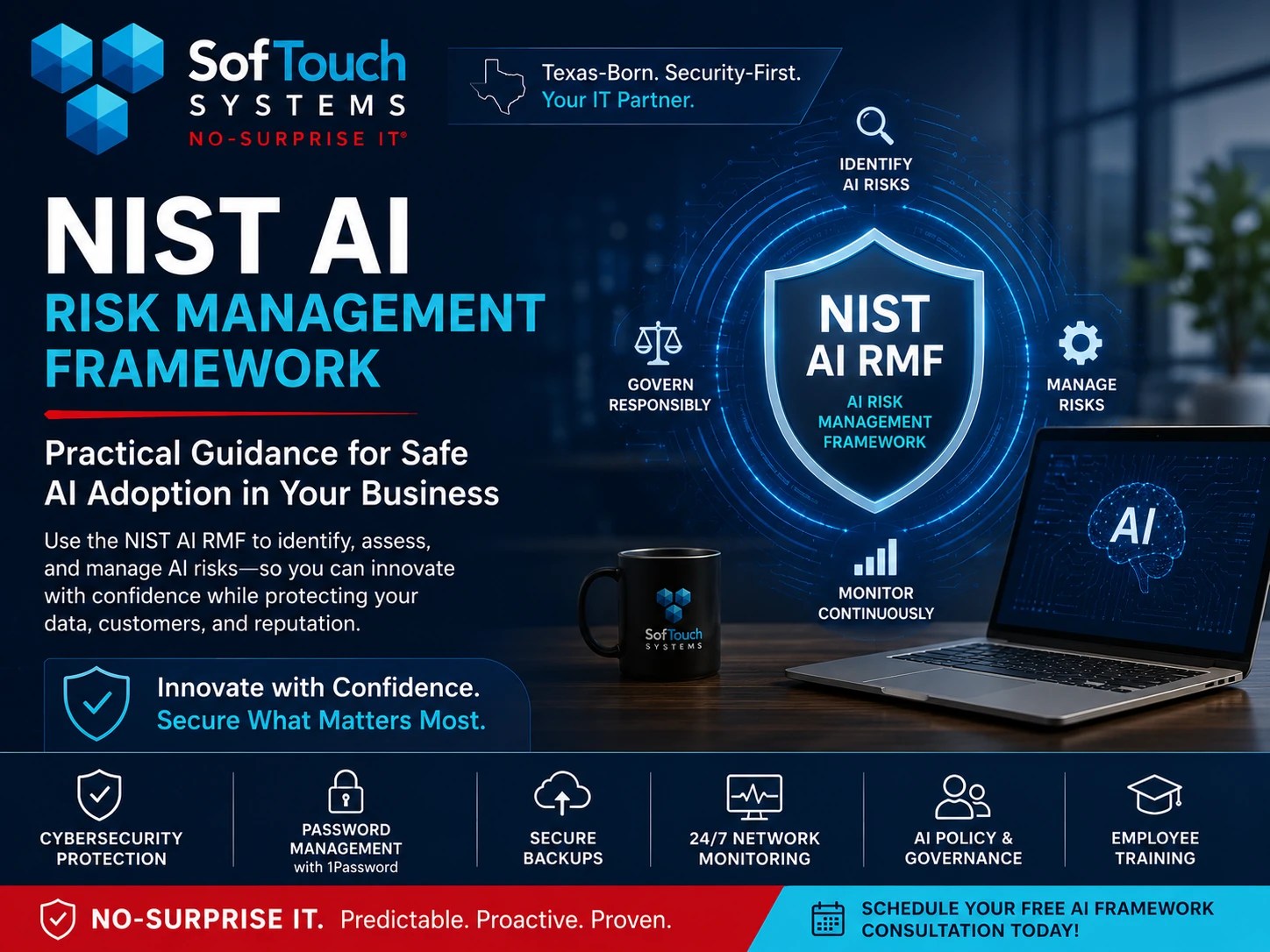
The NIST AI Risk Management Framework (AI RMF) provides practical guidance to help organizations adopt AI responsibly while reducing security, privacy, and business risks.
What Is NIST?
The National Institute of Standards and Technology (NIST) is a U.S. government agency within the Department of Commerce. For decades, NIST has developed voluntary cybersecurity and technology standards used by businesses, government agencies, healthcare organizations, financial institutions, and managed service providers worldwide.
Many organizations already rely on NIST resources, including:
- Cybersecurity Framework (CSF)
- Password guidance
- Zero Trust Architecture
- Digital Identity Guidelines
- AI Risk Management Framework
Unlike regulations, NIST frameworks are voluntary. They are designed to help organizations make informed decisions rather than dictate how technology must be implemented.
Is the NIST AI Risk Management Framework Biased?
This is a fair question.
The answer is not entirely—but it’s also not completely free of perspective.
The framework was developed through an open process involving industry experts, government agencies, universities, technology companies, standards organizations, and public feedback. Its purpose is to improve the trustworthiness of AI systems rather than promote any specific AI vendor or political agenda.
However, the framework does emphasize principles such as:
- Privacy
- Security
- Transparency
- Accountability
- Reliability
- Fairness
These concepts are widely accepted across the technology industry, although organizations may interpret terms like “fairness” or “harmful bias” differently depending on their business, legal, or ethical requirements.
Overall, we view the AI RMF as a practical risk-management framework, not a political document.
What Can You Find on the NIST AI RMF Website?
The website contains far more than the framework itself. It includes a growing collection of free resources that businesses can use to build a safer AI strategy.
Some of the most valuable sections include:
AI Risk Management Framework
The core framework explains how organizations can identify, assess, manage, and monitor AI risks throughout an AI system’s lifecycle.
AI RMF Playbook
The Playbook provides practical examples and implementation guidance that help organizations put the framework into action.
AI Profiles
Profiles allow organizations to adapt the framework to specific industries, business objectives, or use cases.
Resource Center
This section contains guides, publications, examples, references, and supporting documents for organizations that want to learn more.
Crosswalks
Crosswalks compare the AI RMF with other cybersecurity and governance standards, making it easier for organizations already following NIST Cybersecurity Framework, ISO standards, or other compliance programs.
How Should a Small Business Use It?
Many business owners visit the NIST website expecting a step-by-step checklist.
Instead, they discover a large collection of technical documents that can feel overwhelming.
Our recommendation is simple.
Don’t try to implement the entire framework.
Instead, focus on answering practical questions like:
- What AI tools are employees using today?
- Are employees entering confidential information into AI systems?
- Who approves new AI tools?
- Do we have written AI usage policies?
- Are passwords and business accounts protected?
- Can we verify AI-generated information before using it?
Answering these questions will often improve your AI security more than reading hundreds of pages of technical documentation.
Four Steps to Start Today
You don’t need a dedicated AI department to improve your AI security.
Start with these four steps:
1. Identify Your AI Tools
Create a list of every AI platform employees currently use.
2. Protect Business Credentials
Use a business password manager such as 1Password and enable Multi-Factor Authentication (MFA) for every AI account.
3. Create an AI Usage Policy
Clearly define what employees may and may not upload into AI systems.
4. Review Your AI Strategy Regularly
AI changes quickly. Review your policies, tools, and security controls at least twice a year.
Why This Matters
AI adoption is accelerating across every industry.
Businesses that implement AI without planning may expose sensitive customer information, violate internal policies, or create unnecessary cybersecurity risks.
On the other hand, organizations that establish clear governance now will be better positioned to take advantage of future AI innovations safely and confidently.
The goal isn’t to slow AI adoption.
The goal is to adopt AI responsibly.
How SofTouch Systems Can Help
Reading the NIST AI Risk Management Framework is a great first step.
Implementing it is another challenge.
At SofTouch Systems, we help small businesses translate technical guidance into practical business solutions. Rather than handing you hundreds of pages of documentation, we help you identify the parts that matter most to your organization.
Our AI Business Solutions services can help you:
- Evaluate AI platforms before deployment
- Develop practical AI usage policies
- Protect business accounts with 1Password and MFA
- Review data privacy and security risks
- Train employees on responsible AI use
- Build a secure AI roadmap that aligns with your business goals
You don’t need to become an AI expert to use AI effectively, you need a trusted technology partner.
Final Thoughts
The NIST AI Risk Management Framework is one of the best free resources available for organizations that want to adopt AI responsibly. While it isn’t a quick-start guide, it provides valuable principles that can help businesses improve security, reduce risk, and make better technology decisions.
Instead of viewing AI governance as another compliance exercise, think of it as an opportunity to build a stronger, more resilient business.
FAQ
The NIST AI Risk Management Framework (AI RMF) is a voluntary framework developed by the National Institute of Standards and Technology (NIST). It helps organizations identify, assess, manage, and monitor risks associated with artificial intelligence while encouraging responsible and trustworthy AI adoption.
No. The AI RMF is completely voluntary. It is not a law or regulation. Instead, it provides best practices that organizations can adopt to improve AI governance, security, privacy, and risk management.
The framework is designed for organizations of all sizes, including small businesses, nonprofits, healthcare providers, educational institutions, manufacturers, and government agencies. Even if your business only uses AI tools like ChatGPT, Microsoft Copilot, Claude, or Gemini, the framework can help you establish safer AI practices.
The framework is generally considered non-partisan and technology-neutral. It was developed through an open collaboration involving industry leaders, academic researchers, government agencies, standards organizations, and public feedback. While it promotes principles such as fairness, transparency, accountability, and privacy, it does not recommend specific AI vendors or political viewpoints.
Implementing the framework can help your business:
– Protect sensitive company and customer data
– Reduce cybersecurity risks
– Create responsible AI usage policies
– Improve employee awareness and training
– Build customer trust
– Prepare for future compliance requirements
– Make better technology investment decisions
Yes. While the AI RMF is not a cybersecurity framework, it complements cybersecurity best practices by encouraging organizations to protect sensitive information, manage access, monitor AI usage, and reduce operational risks associated with AI technologies.
The AI RMF complements the NIST Cybersecurity Framework. The CSF focuses on protecting IT systems and data, while the AI RMF focuses specifically on managing the risks associated with developing, deploying, and using artificial intelligence.
Ready to Build Your AI Framework?
Artificial intelligence can help your business become more productive—but only when it’s implemented with the right security, policies, and governance.
Schedule a free AI Framework Consultation with SofTouch Systems. We’ll help you evaluate your current AI usage, identify potential risks, develop practical AI policies, and build a secure AI framework tailored to your business. With STS as your technology partner, you can adopt AI confidently while protecting your people, your data, and your reputation.

Discover more from SofTouch Systems
Subscribe to get the latest posts sent to your email.