
Is AI saving your small business time, or simply adding another subscription and another task to check? For a Texas business with a small team, that question deserves a practical answer before you expand access or connect more company information.
A polished draft can feel productive even when an employee spends longer correcting it than writing it. However, a carefully chosen workflow may reduce repetitive work. The difference comes from selecting a useful task and measuring the full process.
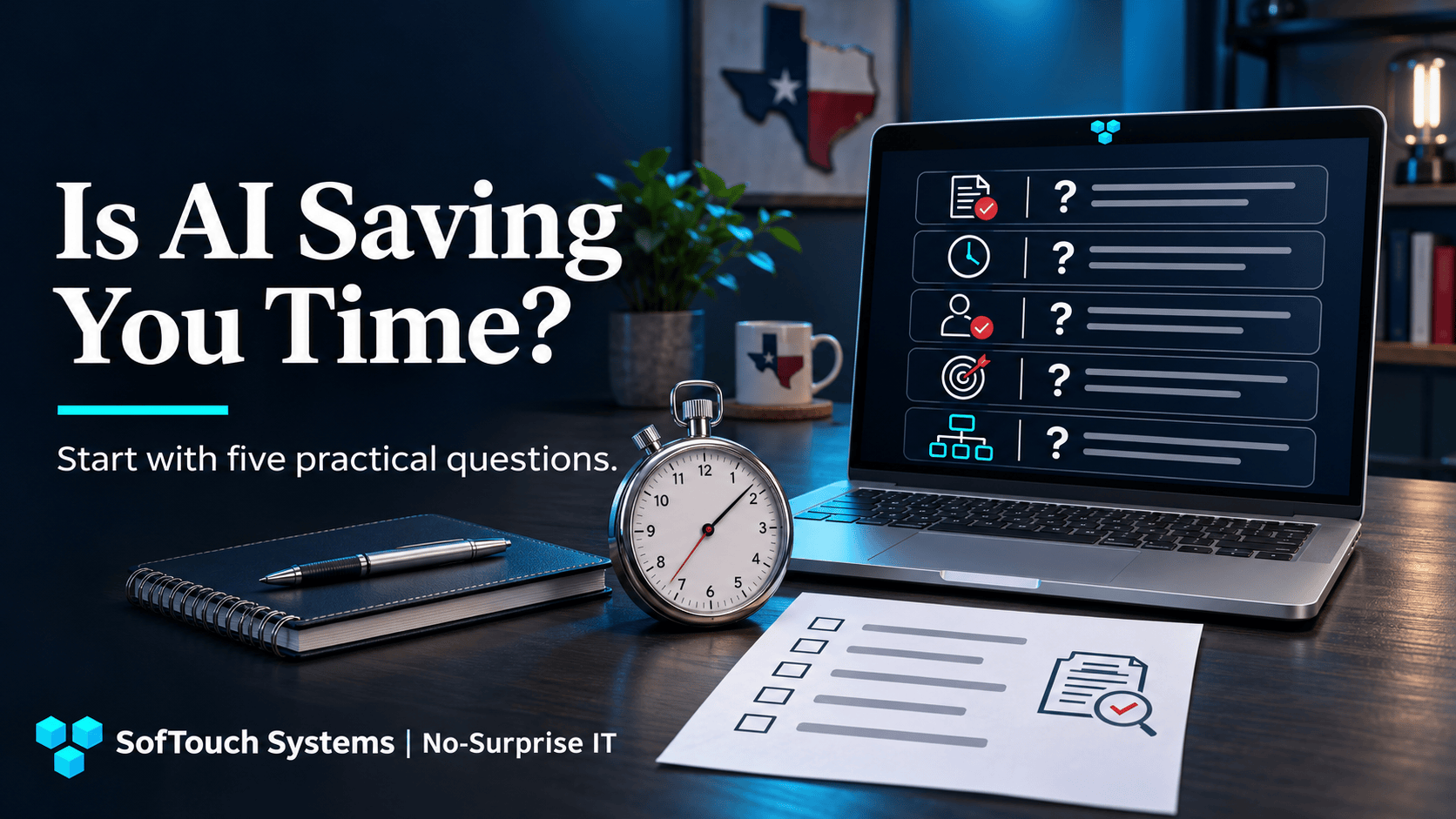
Question 1: Which specific task needs improvement?
Start with a task you can describe in one sentence. For example: draft a follow-up email from approved meeting notes.
Avoid starting with a broad goal such as improving productivity across the office. That makes it difficult to measure results or assign responsibility.
Next, ask how often the task occurs and who performs it. A task that takes ten minutes once a year offers a different opportunity from one that takes ten minutes every day.
Also consider whether a simpler change would help. A reusable template, better filing system, or clearer procedure may solve the problem without introducing AI.
Question 2: How long does the whole task take now?
Measure the existing process from start to approved completion. Include preparation, checking, and filing.
Use several representative tasks rather than one unusually easy example. Then record the range of completion times and any common sources of rework.
When you test AI, measure the same boundaries. Include preparing the input, reviewing the response, correcting errors, and moving the result into the business system.
Otherwise, you may compare a finished manual task with an unfinished AI draft. That comparison overstates the benefit.
Question 3: What counts as a useful result?
Agree on quality before the test. A good customer email might need the correct name, accurate dates, approved pricing, a clear next step, and an appropriate tone.
For a summary, the standard might include every decision and action owner. For document sorting, it might mean placing each file in the correct category.
Then decide which mistakes require stopping the test. An invented customer commitment deserves different treatment from an awkward sentence.
A person with the relevant business knowledge should judge the output. Fluent wording alone does not prove accuracy.
Question 4: Can you test it with appropriate data?
Before employees paste information into a tool, confirm the approved service, account type, settings, and company rules. Review current vendor terms for the intended use.
For an early test, use fictional or properly prepared information wherever practical. However, removing a name alone may not remove every identifying detail.
Avoid using live customer, employee, health, legal, or financial records merely because they are easy to find. Choose a test design that lets you learn without unnecessary exposure.
Our AI use policy guide provides related business guidance. Your policy should explain approved use, review responsibilities, and where employees can ask questions.
Question 5: What will the business do with saved time?
Time saved does not automatically become cash saved. If an employee finishes earlier but the business changes nothing else, payroll may stay the same.
However, recovered time can still matter. Staff might answer customers sooner, reduce backlogs, or complete work that otherwise waits.
Choose the intended outcome before the test. Then check whether the business actually achieved it.
Similarly, include subscription costs, training, administration, and human review. An AI workflow should earn its place alongside other business expenses.
Use this free opportunity scorecard
Copy the questions below into your next team meeting. Write a short answer for each candidate task.
| Question | Your answer |
|---|---|
| Task | What repeatable activity will we test? |
| Baseline | How long does approved completion take now? |
| Quality | What must the final result get right? |
| Data | What information may the tool receive? |
| Outcome | How will we use any recovered capacity? |
| Decision | Who will decide whether the test continues? |
Choose one task with clear answers. If the team cannot explain the quality standard or data rules, resolve those gaps before expanding the experiment.
A fictional small-business example
Imagine a six-person landscaping company preparing appointment follow-ups. The office manager currently starts each message from scratch.
First, the company tries a standard email template. That removes some repetitive work. Next, it tests whether an approved AI tool can adapt the template from fictional appointment notes.
The reviewer checks dates, services, and promises before anything goes to a customer. Meanwhile, the team records the full time needed for each method.
At the end, the business may choose the template, the AI-assisted process, or a combination. A useful test does not need to prove that AI always wins.
Free guidance for a safer decision
The NIST AI RMF Playbook is free to read. Use selected prompts relevant to your workflow rather than trying to adopt every suggestion.
For practical examples, see our AI meeting-summary workflow. Then apply the five questions to your own circumstances.
Frequently asked questions
Not necessarily. Include preparation, review, correction, and final delivery before comparing the two methods.
An approved tool list and clear process make evaluation easier. Separate unmanaged accounts can complicate data handling, support, and spending.
Keep the finding. You have avoided expanding an ineffective process and learned what needs improvement.
Choose one useful AI workflow
SofTouch Systems approaches AI through education, safe implementation, practical workflows, and ongoing support. Request an AI business evaluation to discuss one repetitive task your small Texas team wants to improve.

Discover more from SofTouch Systems
Subscribe to get the latest posts sent to your email.