
Claude Corps for nonprofits could become one of the most useful AI opportunities mission-driven organizations see this year. Anthropic has announced Claude Corps, a national fellowship program designed to place trained early-career AI talent inside U.S. nonprofits for one year.
For nonprofit leaders, that sounds exciting. It should. However, the real value will not come from simply “getting AI.” The value will come from knowing what to do with it, what data to protect, which workflows to improve, and how to keep the organization’s mission at the center.
That is where SofTouch Systems wants nonprofit leaders to slow down, plan clearly, and avoid the usual technology trap.
A free AI opportunity is only useful if your organization is ready to use it safely.
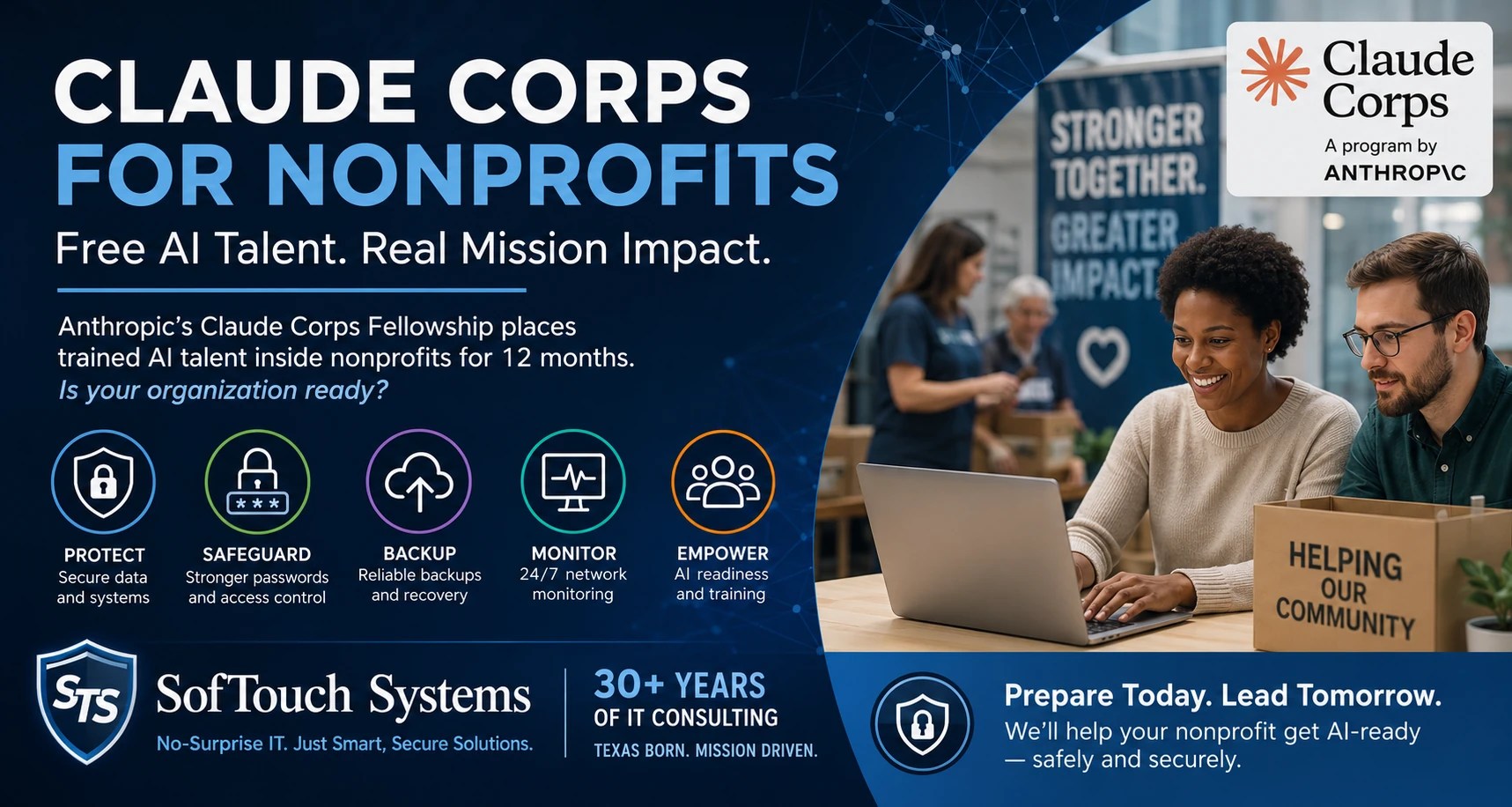
What Is Claude Corps?
Claude Corps is a fully funded fellowship program from Anthropic, the company behind Claude. The program will train early-career fellows to use Claude in nonprofit settings, then place those fellows inside mission-driven organizations across the United States.
The goal is practical. Nonprofits often have big missions, small teams, limited budgets, and too much manual work. Claude Corps aims to help those organizations use AI to improve operations, analyze information, build tools, and serve their communities more effectively.
Anthropic says the first cohort will begin in October 2026, with additional cohorts planned for January 2027 and August 2027. The full program is expected to include 1,000 fellows across three cohorts.
Host organizations may receive a full-time fellow for 12 months, support from Anthropic and CodePath, Claude access, implementation help, and a small grant to help cover operational hosting costs.
That is a serious opportunity for nonprofits.
Still, opportunity does not equal readiness.
Why This Matters for Nonprofits
Most nonprofits already operate under pressure. Staff members handle donor communication, client records, grant reporting, volunteer coordination, event planning, compliance, outreach, and day-to-day service delivery.
That creates a simple problem: the people closest to the mission often spend too much time buried in admin work.
AI can help with that.
A nonprofit could use AI to summarize reports, organize donor notes, draft outreach messages, review intake forms, build internal knowledge bases, analyze program data, or help staff find information faster. Those are not flashy uses. They are practical uses. Practical is where nonprofits usually get the best return.
For example, a food bank may use AI to review distribution trends and prepare better internal reports. A veterans nonprofit may use AI to organize program data and improve member outreach. A legal aid clinic may use AI to help route intake requests. A youth organization may use AI to turn messy program notes into clearer reports for funders.
Those examples matter because they show where AI should start: with bottlenecks, not buzzwords.
The Hidden Risk: AI Without a Plan
Here is the part nonprofit leaders should not ignore.
AI can save time, but it can also create new risks. Staff may paste sensitive client information into tools without approval. Donor records may be copied into the wrong platform. Confidential case notes may end up in prompts. Grant documents may include private details that require controlled access. Volunteers may start using personal AI accounts for organizational work.
That is how a helpful tool becomes a governance problem.
Nonprofits often handle sensitive information, including donor data, health-related details, family information, financial records, student records, veteran support data, or case management notes. Even small nonprofits need clear rules before AI enters daily operations.
The safe path is not “ban AI.” That usually fails.
The safe path is to create a simple AI use policy, train staff, protect accounts, manage access, and decide which tasks are approved before employees start experimenting.
How Nonprofits Should Prepare Before Applying
Claude Corps may provide talent, training, and AI help. However, host organizations still need internal readiness. Anthropic’s host guidance makes clear that nonprofits need a sponsor, a supervisor, equipment, system access, and a plan for what the fellow will work on.
That means nonprofit leaders should prepare before they apply.
Start with a simple internal question: What work slows down our mission every week?
Do not begin with “How can we use AI?” That question is too broad. Instead, identify the pain points that consume staff time.
Look for tasks such as:
- Rewriting the same donor emails
- Manually sorting intake requests
- Searching through old documents
- Preparing grant updates
- Summarizing meeting notes
- Cleaning up spreadsheets
- Tracking program outcomes
- Creating volunteer instructions
- Drafting board reports
- Organizing client resource information
Once those problems are clear, the AI conversation becomes much more useful.
A Claude Corps fellow can do more with a clear workflow than with a vague wish list.
A Practical AI Readiness Checklist for Nonprofits
Before a nonprofit brings in AI talent, it should answer these questions:
- What data do we collect, and where is it stored?
- Which files include sensitive client, donor, employee, or financial information?
- Who has access to those files?
- Do we use multi-factor authentication on email, cloud drives, and admin accounts?
- Are passwords stored securely, or are staff still using spreadsheets, browsers, notebooks, or reused passwords?
- Do we have a written AI use policy?
- Which AI tasks are approved, restricted, or prohibited?
- Are backups working and tested?
- Do staff know what information should never be pasted into an AI tool?
- Do we have someone responsible for reviewing AI-generated work before it goes public?
If the answer to several of those questions is “not sure,” that is not a failure. It is a warning light.
This is exactly where SofTouch Systems can help.
Where SofTouch Systems Fits In
SofTouch Systems helps nonprofits turn technology into something useful, secure, and manageable. We are not here to throw jargon at your board or sell AI like magic. We are here to help you use the right tools, protect the right data, and avoid expensive mistakes.
For nonprofits interested in Claude Corps, STS can help with the preparation work that makes the fellowship more valuable.
That includes:
- AI readiness reviews
- Data privacy checks
- Password security reviews
- 1Password onboarding
- MFA setup and training
- Cloud file access review
- Backup and recovery verification
- Staff AI usage policy support
- Workflow mapping
- Safe AI implementation planning
- Managed IT support for nonprofit teams
Claude Corps may bring the AI fellow. STS can help make sure your systems, staff, and security are ready before that fellow arrives.
That matters because AI cannot fix a disorganized IT foundation. If files are scattered, passwords are weak, backups are untested, and no one knows who has access to what, AI may only help you move faster in the wrong direction.
No-Surprise IT means we help you see the risks before they become problems.
Good AI Projects for Nonprofits
Not every task should be handed to AI. Nonprofits should begin with low-risk, high-value workflows.
Strong starting projects include:
Grant support: Summarize program outcomes, organize reporting notes, and draft first-pass language for human review.
Volunteer coordination: Create onboarding guides, role descriptions, checklists, and follow-up messages.
Internal knowledge base: Turn scattered procedures into searchable internal documents.
Donor communication: Draft segmented email templates while keeping donor records protected.
Program reporting: Summarize anonymized survey results or service metrics for leadership review.
Staff training: Create short guides explaining policies, cybersecurity basics, and safe technology practices.
Client resource organization: Build staff-facing guides that help employees find approved community resources faster.
The key is simple: start where AI reduces administrative drag without exposing sensitive information.
What Nonprofits Should Avoid
Some AI uses carry more risk and need extra review.
Nonprofits should be careful with:
- Client case notes
- Health information
- Legal information
- Student records
- Donor financial details
- Employee records
- Social Security numbers
- Passwords or API keys
- Confidential board documents
- Unreviewed public-facing advice
AI output should also be reviewed by a person before it goes to clients, donors, partners, or the public. AI can help draft, organize, and summarize. It should not replace professional judgment, legal review, clinical judgment, or human care.
This is especially important for nonprofits serving vulnerable communities.
The goal is not to replace people. The goal is to give people more time to do the work only humans can do.
The SofTouch Systems “Roadmap Before Rollout” Approach
STS recommends a simple four-step approach before any nonprofit starts using AI seriously.
Step 1: Secure the basics
Start with passwords, MFA, device protection, backups, and access controls. If those basics are weak, AI adoption adds risk.
Step 2: Map the workflow
Pick one painful process. Write down who handles it, what tools they use, where the data lives, and what slows them down.
Step 3: Define safe AI use
Decide what information can be used, what must be anonymized, who reviews output, and where finished work is stored.
Step 4: Train the team
Staff need plain-English training. They should know what AI can do, what it should not do, and when to ask for help.
That is how nonprofits turn AI from a novelty into a working tool.
Why This Is a Texas Nonprofit Opportunity
Texas nonprofits serve large communities with lean teams. Food banks, churches, veteran support groups, local clinics, youth organizations, shelters, and community programs often carry more responsibility than their budgets suggest.
Claude Corps could give some of those organizations access to AI support they could not normally afford.
However, not every nonprofit will be selected. That means the bigger lesson still matters for everyone: AI readiness is now part of nonprofit operations.
Even if your organization never hosts a Claude Corps fellow, you still need a plan for AI. Your staff may already be using it. Most likely your donors may expect better reporting. The board may ask about efficiency. Clients always need faster service. Your cyber insurance provider may ask harder questions about security controls.
Waiting is not a strategy.
Planning is.
Final Takeaway
Claude Corps for nonprofits is important because it points to where nonprofit technology is heading. AI will not stay locked inside large corporations. It is moving into food banks, veteran services, education programs, public health groups, legal aid clinics, and community organizations.
That is good news, but only for organizations that prepare.
Nonprofits should look at Claude Corps as both an opportunity and a wake-up call. The organizations that benefit most will be the ones that know their data, secure their systems, train their people, and choose practical workflows before chasing big AI promises.
SofTouch Systems can help your nonprofit get ready.
If your organization wants to explore AI safely, start with a plain-English AI readiness review. STS will help you identify where AI can save time, where your data needs better protection, and what steps you should take before staff start using new tools.
No hype. No confusion. No surprise IT.
Just practical technology that helps your mission move forward.
Discover more from SofTouch Systems
Subscribe to get the latest posts sent to your email.