
AI agent security is becoming a practical business issue, not a problem reserved for technology companies.
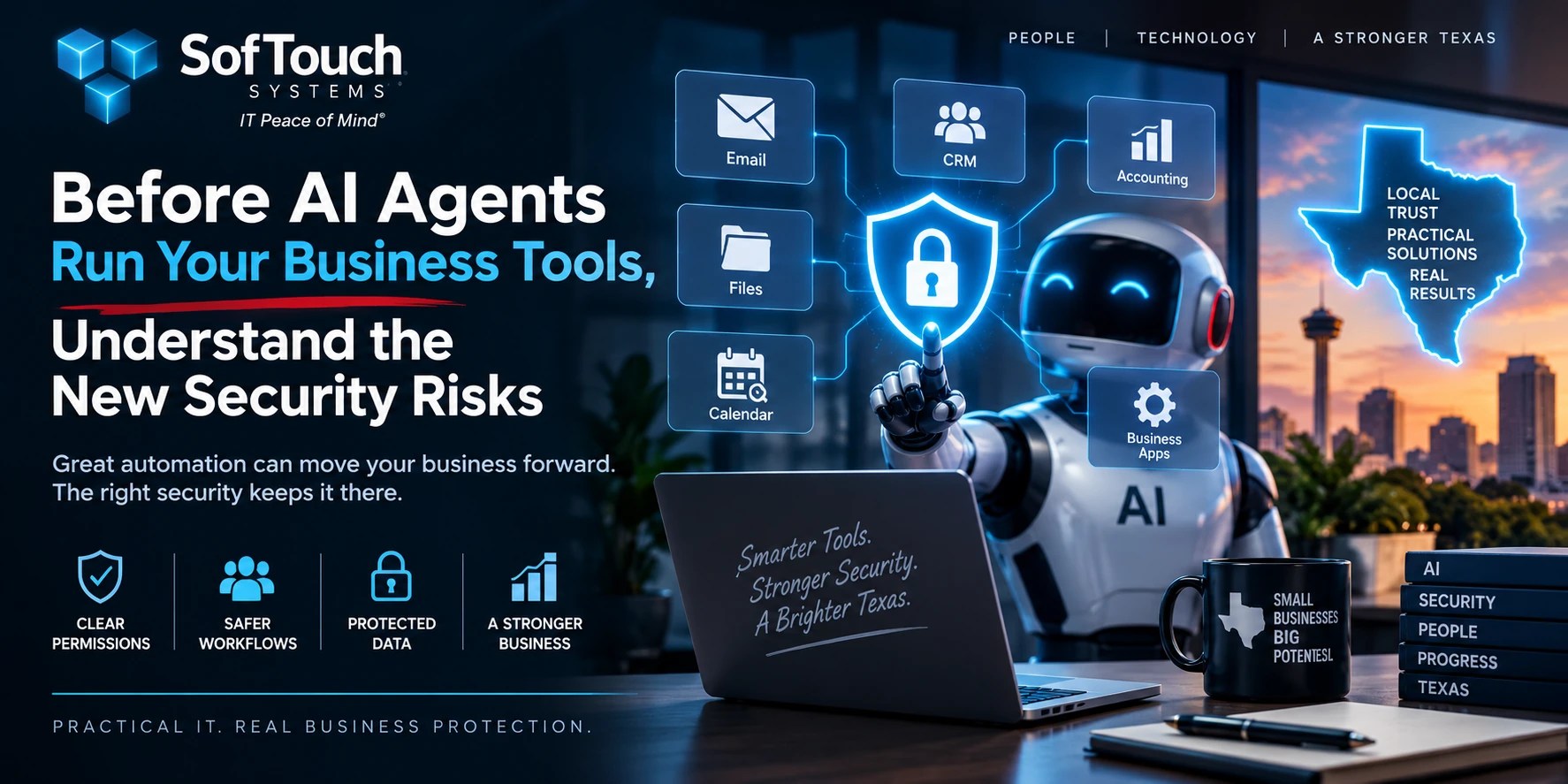
Small businesses are beginning to use AI agents to manage email, update CRM records, organize files, research customers, create invoices, schedule meetings, and automate routine workflows.
That sounds useful because it is.
However, an AI agent is fundamentally different from a chatbot that answers a question and waits for another prompt.
An agent can take action.
Once an AI agent gains access to your email, files, accounting system, customer database, or other business tools, the security question changes.
It is no longer simply:
“What information are employees giving the AI?”
The more important question becomes:
“What authority have we given the AI to act?”
Federal cybersecurity officials, technology companies, and now lawmakers are paying much closer attention to that question.
Small businesses should too.
What Is an AI Agent?
An AI agent is software that can use artificial intelligence to complete tasks across one or more systems.
A normal AI chatbot may draft an email for you.
An AI agent could potentially:
- Read the incoming message.
- Find information in your CRM.
- Write the response.
- Attach a document.
- Send the email.
- Update the customer record.
- Schedule a follow-up appointment.
That level of automation can save considerable time.
However, every additional permission gives the agent something else it can access or change.
Microsoft describes modern agents as systems capable of planning actions, using tools, and chaining tasks across multiple systems without a human approving every individual step.
That is where the security discussion begins.
Why Is AI Agent Security Suddenly Getting More Attention?
The federal government has spent much of 2026 studying how AI agents should be secured.
In February, the National Institute of Standards and Technology launched an AI Agent Standards Initiative focused partly on agent security, identity, and trusted adoption.
NIST later reported broad agreement among security experts that AI agents create new risks that traditional cybersecurity practices must be adapted to address.
Now Congress is entering the discussion.
On September 3, 2026, Representatives Josh Gottheimer and Mike Lawler introduced the Stop Rogue AI Act.
The proposed legislation would direct NIST to develop standards, guidelines, and best practices for securely deploying AI agents.
Those recommendations would address issues such as monitoring agent behavior, evaluating agent security, and maintaining trustworthy records of what agents do.
The proposal is not law.
However, it is another sign that AI agent security has moved from a theoretical discussion toward practical governance.
The Biggest Risk May Be Permissions
Suppose a business creates an AI agent to help manage customer accounts.
To do its job, the agent receives access to:
- Business email
- CRM records
- Customer files
- Calendar
- Cloud storage
Later, someone connects it to the accounting system.
Then another integration allows it to create invoices.
Eventually, the agent may have access to far more information than anyone originally intended.
This is known as permission creep.
Microsoft warns that teams often grant broad permissions during AI pilots so systems will work quickly. Those permissions may remain long after the testing phase ends.
For a small business, that can create a powerful digital account with access across several important systems.
If the agent makes a mistake, gets manipulated, or becomes compromised, those permissions determine how much damage is possible.
AI Agents Need Their Own Identity
Businesses already understand this concept with employees.
Susan in accounting should have her own login.
John in sales should have his own login.
Employees should not all share the owner’s administrator account.
AI agents should follow similar rules.
Microsoft recommends giving agents their own identities instead of allowing them to operate through shared or borrowed credentials.
That creates accountability.
If an AI agent modifies a customer file, sends an email, or accesses financial information, administrators should be able to determine:
Which agent performed the action?
What account did it use?
What information did it access?
Who authorized that access?
When did the action occur?
Without clear agent identities, those questions become much harder to answer.
Follow the Principle of Least Privilege
One of the oldest cybersecurity principles may become one of the most important rules for business AI.
It is called least privilege.
The concept is straightforward:
Give an account only the access it needs to perform its job.
Nothing more.
If an AI agent only needs to read appointment information, it should not automatically receive permission to delete appointments.
Or if it needs customer names and phone numbers, it may not need access to payment information.
Also, if the agent drafts invoices, it does not necessarily need authority to approve refunds.
Microsoft recommends starting AI-agent permissions from zero and explicitly enabling necessary actions.
That approach limits the potential impact when something goes wrong.
Prompt Injection Becomes More Serious When AI Can Take Action
Businesses also need to understand prompt injection.
A prompt injection attack attempts to place instructions inside information an AI system processes.
Consider an AI agent that reads customer emails.
An attacker could send an email containing hidden or misleading instructions designed to influence the agent.
The goal might be to convince the AI to reveal information, access another system, download something dangerous, or perform an unauthorized action.
NIST specifically identifies indirect prompt injection, sometimes called agent hijacking, as a major AI-agent security concern.
The danger increases when an agent has three capabilities at the same time:
The AI can process information from untrusted sources.
It can access sensitive business data.
It can change information or communicate externally.
That combination deserves particularly careful controls.
An AI Agent Could Make a Perfectly Authorized Mistake
Not every AI security incident requires a hacker.
An AI agent can simply misunderstand instructions.
For example, imagine telling an AI system:
“Clean up inactive customer records.”
What does inactive mean?
Six months without a purchase?
One year?
Does cleanup mean archive?
Remove from a mailing list?
Delete?
Now imagine the agent has permission to modify the CRM automatically.
A vague instruction can become a real business action.
Anthropic notes that agent autonomy creates more opportunities for AI systems to misunderstand user intent and take unintended actions.
Therefore, businesses should identify actions that always require human approval.
These might include:
- Sending money
- Issuing refunds
- Deleting records
- Changing employee access
- Sending sensitive documents
- Modifying financial information
- Publishing public content
- Changing security settings
AI can prepare the action.
A person can approve the decision.
That small distinction can significantly reduce risk.
What About AI Agents in Accounting?
Accounting is one area where businesses should move carefully.
AI agents can help categorize expenses, organize receipts, prepare reports, identify unusual transactions, and automate repetitive bookkeeping work.
However, financial systems contain some of the business’s most sensitive information.
An accounting agent may encounter:
- Bank information
- Payroll
- Tax records
- Vendor accounts
- Customer payments
- Financial statements
Therefore, giving an AI agent unrestricted accounting access would be difficult to justify.
A safer approach is to separate reading, preparing, approving, and executing financial actions.
An agent might prepare a transaction.
A human should approve high-risk actions.
What About CRM and Customer Data?
CRM systems create another attractive use case.
AI agents can summarize customer histories, prepare follow-up emails, update notes, identify sales opportunities, and schedule tasks.
However, CRM platforms often contain more information than employees realize.
A CRM may include names, addresses, phone numbers, contracts, sales history, internal notes, payment information, and other private data.
An agent that does not need all of that information should not receive access to all of it.
This is where security and productivity need to work together.
The objective is not to prevent AI from being useful.
The objective is to give AI enough access to complete the task without giving it unnecessary authority.
Don’t Forget Email
Email may become one of the most useful and dangerous agent integrations.
An AI agent could:
Read incoming messages.
Determine their importance.
Find supporting documents.
Draft responses.
Schedule appointments.
Forward information.
Update another business system.
That saves time.
It also creates an attractive pathway for malicious content to reach an AI system.
Businesses should therefore be cautious about allowing agents to automatically act on every incoming message.
High-risk actions should have additional checks.
Every AI Agent Should Have an Owner
Small businesses should also assign human responsibility for every agent.
Someone should know:
What the agent does.
Which systems it accesses.
Which account it uses.
What permissions it has.
Which integrations are connected.
Whether its activity is logged.
How to shut it down.
When its access was last reviewed.
Microsoft recommends maintaining an inventory of AI agents and identifying their owners, permissions, data access, and behavior.
Without that inventory, businesses could eventually experience AI agent sprawl.
Employees create useful automations.
Departments connect new tools.
Old agents remain active.
Credentials remain valid.
Nobody remembers exactly what still has access.
Small businesses have already experienced this problem with unused cloud applications and old employee accounts.
AI agents could make the problem larger.
A Practical AI Agent Security Checklist for Small Businesses
Before connecting an AI agent to business systems, answer these questions:
- What exact job does this agent perform?
- What information must it access?
- Which systems does it connect to?
- Can it only read information, or can it change information?
- Can it send email or communicate outside the company?
- Can it delete files or records?
- Can it perform financial actions?
- Does it have its own identity and credentials?
- Are its activities logged?
- Which actions require human approval?
- Who owns and reviews the agent?
- How quickly can its access be revoked?
If nobody can answer those questions, the business probably is not ready to give the agent broad access.
Small Businesses Should Not Avoid AI Agents
The lesson here is not “AI agents are too dangerous.”
That would ignore their potential value.
Agents could help small businesses automate repetitive administrative work that currently consumes hours every week.
They may improve customer response times.
They can assist with research.
And they can reduce manual data entry.
Or they may help small teams accomplish work that previously required another employee or outside service.
However, AI should not receive unrestricted business access simply because the technology is convenient.
That leads to a better adoption strategy:
Education first.
Understand what the agent does.
Safe implementation second.
Control identity, permissions, integrations, and data access.
Workflow improvement third.
Automate tasks where AI provides clear business value.
Ongoing support fourth.
Monitor what the agent does and adjust controls as the workflow changes.
That is a much safer path than connecting an AI tool to everything and hoping the guardrails work.
AI Security Is Becoming Business Security
For years, businesses have protected employee accounts because those accounts can access valuable systems.
AI agents deserve similar attention.
An agent capable of reading email, editing a CRM, searching cloud storage, and initiating workflows is effectively another digital worker.
Except that worker may operate faster than a person and across several systems at once.
That changes the risk.
Therefore, the key question for Texas small businesses considering AI agents should not be:
“Can AI automate this?”
It should be:
“How do we allow AI to automate this safely?”
SofTouch Systems believes small businesses can benefit from AI without handing over unnecessary control.
The right approach combines useful automation with clear policies, limited permissions, protected data, human oversight, and ongoing IT security.
FAQ
An AI agent is software that uses artificial intelligence to plan tasks and take actions using connected tools, applications, or data. Unlike a basic chatbot, an agent may perform multi-step work with limited human involvement.
They can be used safely when access is limited, sensitive actions require approval, activity is monitored, and the business understands which systems and data the agent can reach.
Excessive permissions are one of the biggest practical risks. An AI agent with unnecessary access can increase the impact of mistakes, prompt injection, stolen credentials, or compromised integrations.
Prompt injection is an attack that attempts to manipulate an AI system through malicious instructions hidden or embedded in content the AI processes. AI agents that read email, websites, files, or other outside information can face this risk.
Generally, an agent should receive only the permissions required for its specific job. Broad administrator access conflicts with the cybersecurity principle of least privilege.
Where the platform supports it, giving agents distinct identities improves access control, logging, accountability, and the ability to revoke permissions.
No. As of September 4, 2026, it is proposed federal legislation. The bill would direct NIST to develop standards and best practices for secure AI-agent deployment.

Ready to Explore AI Without Giving It the Keys to Everything?
If your business is considering AI agents for email, CRM, accounting, customer service, or workflow automation, start with the security questions before connecting the systems.
SofTouch Systems can help you evaluate the workflow, identify the risks, and build a practical AI implementation plan for your business.
Schedule a free 15-minute AI and IT security review to discuss what you want to automate and what should stay protected.
Discover more from SofTouch Systems
Subscribe to get the latest posts sent to your email.