
A 30-day AI pilot gives a small business a structured way to test one workflow before expanding it. For a Texas team with limited time and budget, the point is to learn whether the process improves real work under clear rules.
Thirty days is a suggested planning window, not a guarantee of meaningful results. If the task occurs only twice during the month, you may need a longer or differently designed test. Start with a workflow that produces enough examples to evaluate.
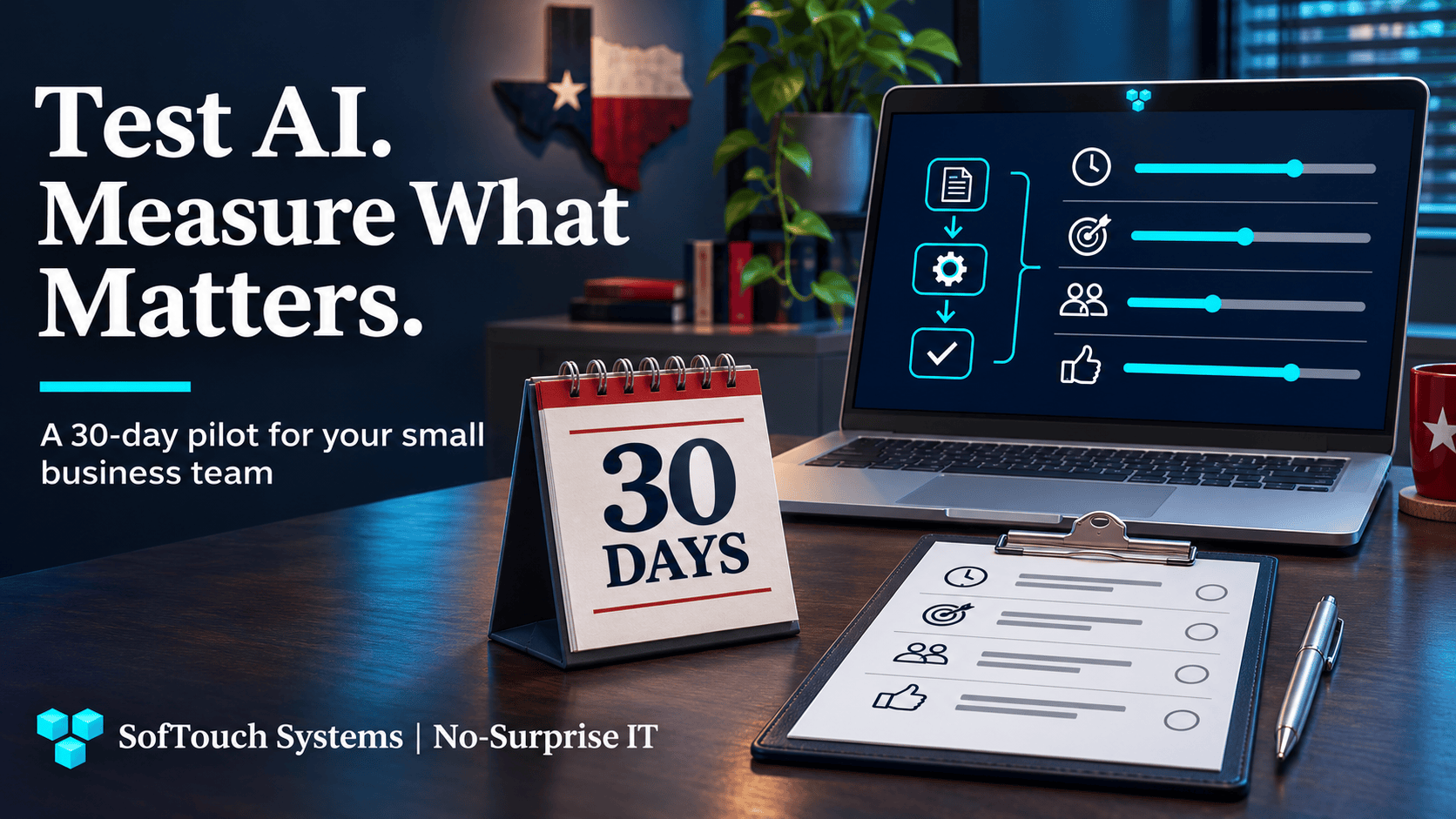
Define the pilot on one page
Write down the task, participants, approved tool, permitted data, reviewer, and decision date. Then identify who can stop the test if something goes wrong.
Keep the scope narrow. Drafting follow-up emails from approved notes is manageable. Letting an agent manage every customer conversation is a much broader experiment.
Also define what the tool may do. For an early pilot, draft-only operation with human approval can make the workflow easier to evaluate.
Do not connect extra applications simply because the tool offers an integration. Each connection creates another question about permissions and oversight.
Week 1: Record the baseline
Observe the existing process across representative examples. Measure the time from gathering input to approving and storing the final result.
Next, record errors and rework. A faster process that creates more corrections may offer little benefit.
Use the same quality checklist for manual and AI-assisted work. For example, a customer follow-up should contain accurate dates, correct services, an approved commitment, and a clear next action.
Keep the sample selection honest. Include typical tasks and difficult examples rather than choosing only the easiest work.
Set data and review rules before testing
Confirm the approved account and current vendor terms. Then decide which information the pilot may use.
Begin with fictional or suitably prepared examples when practical. If the workflow requires sensitive live records, obtain the appropriate business review before proceeding.
Assign a reviewer who understands the work. That person should check the output against source information rather than approving it because the writing sounds confident.
Our AI privacy guide explains related concerns. The pilot should follow your company’s rules instead of replacing them.
Week 2: Run a small controlled trial
Test the documented workflow with a few participants. Record the tool and configuration used so later results have context.
For each task, capture preparation time, generation time, review time, and correction time. Then note whether the final result met the agreed standard.
If the tool invents facts or mishandles information, pause the affected workflow and investigate. Do not quietly remove the example from the scorecard.
Likewise, keep a fallback method available. Employees should know how to complete the task if the AI service is unavailable or unsuitable.
Week 3: Test representative variation
Once the basic process works, try the range of tasks the team expects to encounter. Include incomplete notes, unusual wording, and requests outside the normal pattern.
However, do not add more departments or integrations just to make the pilot look ambitious. You still need a clear comparison.
Record any instruction changes. If you substantially redesign the workflow, separate results from before and after that change.
Next, ask participants where the process feels awkward. Extra copying, logging in, or formatting can erase a small drafting benefit.
Use a scorecard that shows the whole job
Copy this table into a spreadsheet. Add one row for each completed example and summarize results weekly.
| Measure | What to record |
|---|---|
| Task type | The kind and difficulty of work |
| Manual baseline | Approved completion time without AI |
| AI-assisted completion | Preparation, generation, checking, and corrections |
| Quality | Pass, revision needed, or unacceptable |
| Exception | Error, data concern, or process failure |
| Business result | What the recovered capacity helped accomplish |
Avoid putting confidential customer details into the tracking sheet. A task identifier and approved description may provide enough context.
Week 4: Make a decision
Choose keep, change, or stop. Support the decision with time, quality, cost, and risk findings.
Keeping the workflow should include an owner, written instructions, employee training, and a review date. Changing it should identify the problem and define the next test.
Stopping it is a valid outcome. For example, the process may save drafting time but require too much specialist review.
Our AI Business Solutions approach starts with education and careful setup. A pilot should lead to a controlled business process rather than an indefinite experiment.
Free resources and realistic expectations
Use the scorecard above without buying a separate evaluation platform. The NIST AI RMF Playbook offers additional reference questions for your review.
The playbook is free. Your chosen AI service may involve subscription or usage costs. Record those expenses separately from staff time.
Treat the pilot as evidence about one workflow in your business. A successful email test does not prove the same tool is suitable for payroll, legal advice, or autonomous transactions.
Frequently asked questions
Use the smallest group that represents the workflow adequately. The right number depends on task variation, oversight, and business needs.
No. Early tests can often use fictional or prepared examples. Any use of sensitive information needs an approved process.
Document the workflow, assign ownership, train staff, and review ongoing performance. Keep human oversight appropriate to the consequences of errors.
Test one task with a clear purpose
Contact SofTouch Systems for an AI business evaluation. We can discuss a practical pilot for your small Texas team, including the rules and measurements that make the result useful.

Discover more from SofTouch Systems
Subscribe to get the latest posts sent to your email.